As I complete my research class through UF, I am piecing together the how, what and why I will complete my capstone project, a unit (and additional tools) which aims to reduce stigma associated with mental health & paper arguing that the arts is a logical first step for discussing mental health in schools. Having just moved to Chattanooga, TN from Alabama, I am at an unusual crossroads career wise, finding myself school-less at present. On the one hand, I feel limited regarding subjects when it comes to who will be my first students as I design and implement this unit. On the other, I feel free to creatively solve this problem. Will I host a weekend-long camp? Will I host a community wide event?
This blog is my first step in charting my progress through this project. I am so excited and a bit nervous to approach the final steps of my MAAE degree. Mostly, I look forward to taking this step to learn more about how we can, through arts ed, increase mental health awareness and to share my research with fellow educators.
Our property in Choccolocco, Alabama has been a labor of love since 2016, when we moved to this rural area. Differing from the community in many ways, our farm, Hippie Hollow, and the people who love it, have a lot of community buzz surrounding what goes on here. Whether we are opening a halfway house, growing weed (not legal here yet!) or UFO watching, it’s always news to us when we hear what we’re up to from the latest “Funny Farm” gossip. Passionate about the arts and the environment, our goal has been to host classes, camps and events for the community—whatever size that is or becomes, all are welcome. It’s just taken us a bit longer to get the infrastructure in place than we’d hoped.
Bringing a welcome structure to the front of my property, facing the main road, and learning to work with stones, a medium that has fascinated me since I was a child stacking rock cairns next to the creek, were my primary goals. I hope that the community can see our passion for found objects, the earth, the arts and our permanence in the community. The artist whose work I am most inspired by for this stone project is Carl Peverall. On his website, he explains that the rock work he does is called “Powhiri” (poe’-fur-ee), which means “welcome” in the Mairi language. I hope myOpen Door is a welcome to all who drive past.
Reflections for Final • June 15, 2020
I think I successfully created the piece I set out to do and had just as many problems in the process as I anticipated. Not one to shy away from a big task, at some point on Thursday after already spending about 20 hours on it, I wondered how I was going to finish it in time. My solution was to work from about 7am until about 7pm for the next two days.
Drilling
The drilling of the rocks was twice as time consuming as I’d anticipated (based on tons of research via YouTube and other DIY videos I’d found on drilling), which also added cost to the project—due to drill bits dulling very quickly and needing replacements. The smaller rocks were difficult, as they broke in half during the process. Toward the end, I started drilling about halfway through, then flipping the rock and trying to ballpark where to drill on the other side to meet in the middle. That was the only way I could find to drill the smaller ones without breaking them. The milky quartz that is in the middle took a 1/8 bit first, then a quarter…was quite time consuming, due to how hard it is and the fact that I did not want to risk breaking it. As mentioned in my project video, I had a friend help drill for the big rebar for the largest, base boulders.
Shape Consideration
I wanted to do an arch. At one point last week, I thought about simplifying it to a pillar but felt like that was a copout. I would like to do pillars in the future, but for this one, I wanted to stick to the idea of my original sketch, although at some point early on, I decided I wanted it less symmetrical than my original drawing. I was not sure if the metal on the top was a strong enough material to stabilize the rock once attached, and I didn’t know until my husband helped me insert the top arch into the base. At that point, we discovered a pretty major lean backwards, away from the road. In the interest of time, I braced it with wood until I can install a permanent solution. After spending so much time, though, on something that is a tad unstable at this point, I think my next one will be balanced by rock positioning, different sizes, etc.
I also thought about using a wet saw next time (like one you use for tile) to cut the side edges of the rocks where they will lay next to each other more perfectly. Basically, I would like to experiment with making it more of a science for the next one.
Zoom Feedback
I enjoyed the opportunity to share my project with peers, and to see in a deeper way what each of them had created. After getting the suggestion to create a video of just observing the piece, I added that to my YouTube channel. I explained my intent with the asymmetry and my vision for the small, five cairn part being representative of my family. I also detailed my intent of this being a welcome piece for the front of my property, hence the title I gave it. Some of the subtle shapes, between and overall, were determined by subtleties in rock shape differences or surfaces where they met. Many rocks were placed (which entailed muscling the rock onto the metal string that barely fit into each hole, then back off, then on…) on the “necklace” 5 or 6 different times prior to getting their permanent spot. While nothing was done by accident, I found it difficult to elaborate any deeper on why I did the shape exactly the way I did, aside from the round side coinciding with the implied motion of the arrow. Finding and placing the right “arrow” rock was a big process, and it was meant to balance the piece visually. In this case, the scale of the piece was almost overwhelming, and after explaining my whys, truly did not understand the additional probing for a thematic novella.
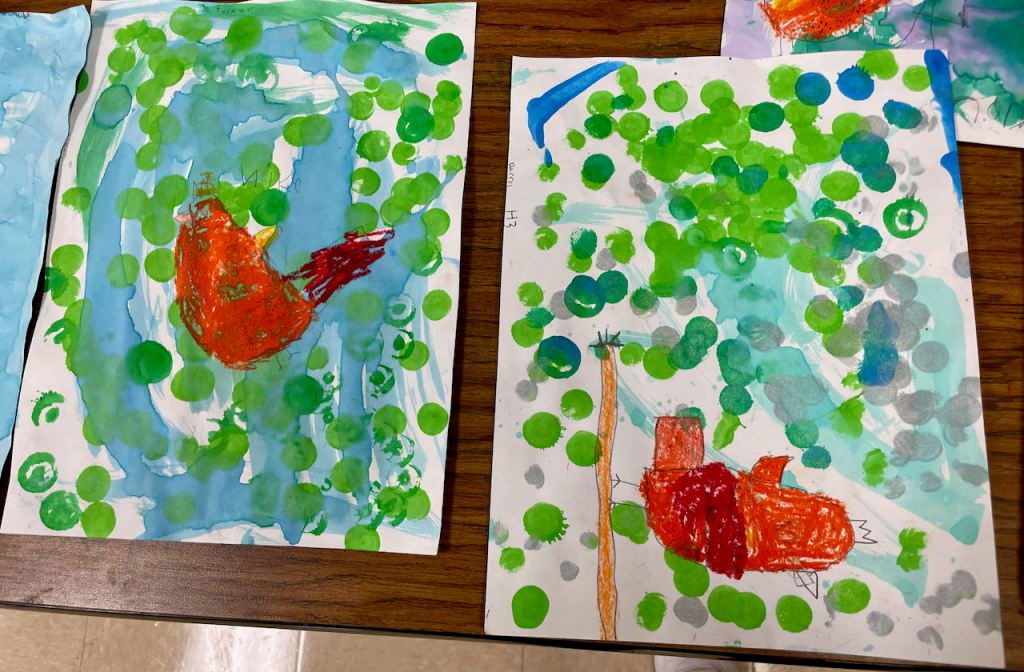
the kids loved this project! some did a bird; some did not!
This is a simple project I did to start the year at my new school. Since I did not know the kids’ level of experience with tools, media and terminology, this was a leap of faith in a sense. I was pleased with the end result, but this is not for the faint of heart if dealing with large class sizes with back to back classes.
Materials: watercolor or mixed media white paper, pastels in warm colors (crayons for the youngest students) + premixed watercolor in various blues- used dog bowls in the center of tables to reduce spills. Optional: dot art markers. You’ll need a lot of paper towels, patience and stacks of scrap white paper to experiment with printmaking during the aftermath. The kids loved this last part the most!
We started out drawing our birds with light pencil lines. The step-by-step can be found here. The youngest classes just drew anything they wanted. When they were finished with this step, I started passing out the blue paints, encouraging them to “wash” the entire page with the cool colors. We talked about contrast and revisited warm/cool colors throughout this project. Due to my jumbled up schedule, I allowed some classes to add the dot art texture to their background before using the watercolor. This was a cool additional step but not necessary for shorter class periods. I encouraged them to cover the white paper.
When tables were muddied with watercolor remnants and accidental spills, I encouraged them to play with the white paper stacks around the classroom. They used hands, brushes, etc. to create lines on the table then experimented with printing. We will use this scrap paper for our next project.
Another blog post describes my thought process over the past few weeks, in tackling this small-scale installation. The original intent was more complicated, including sound and other technologies. However, as I created the frame and woven structures, it became the final product. I felt that to add any additional sound or visual components would be doing it just because. Perhaps, in the future I can add audio and video as a part of an installation with this and other similar sculptures in a group. I fell in love with these materials and enjoyed the process immensely.
By framing my colorful images fading to gray in an iron fence of scrap metal, I create a jungle gym for the caged, a wall against evil spirits and a statement questioning immigration injustices in America. The Huichol Indians of western Mexico call their God’s Eyes “Sikuli,” which means “the power to see and understand things unknown.”The woven string and wood pieces are used across Mexican-Catholic traditions and are thought to cast away evil spirits. A black, cage-like structure literally frames immigration issues our country has faced in recent years, especially regarding children and families crossing the southern US border.
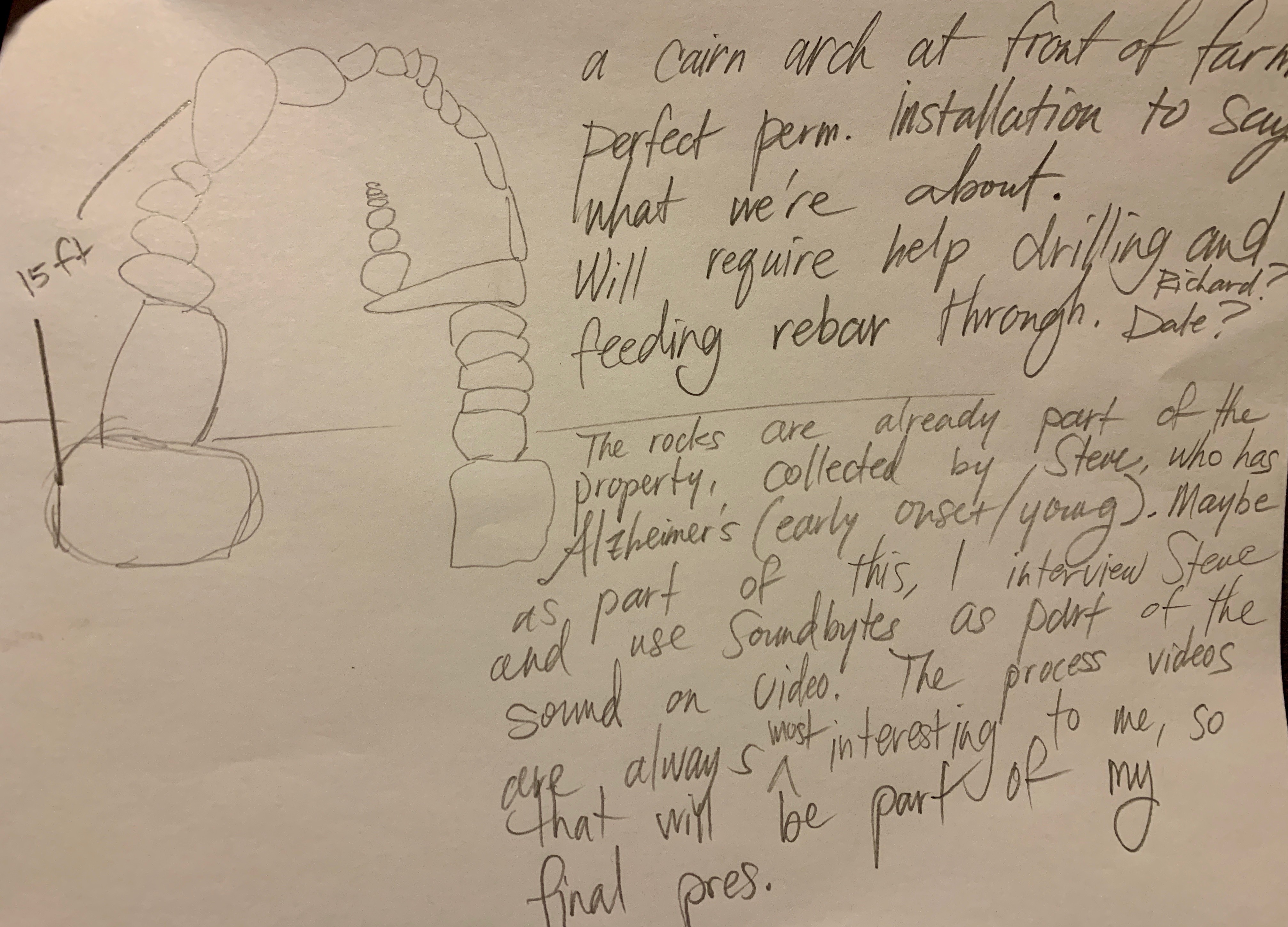
We have a lot of extra rocks at our farm. Over the past year, we’ve hired a great guy, Steve, who has early onset Alzheimer’s. In creating this installation, I thought I might get footage of Steve working, talking, telling stories and include that video footage with the video of the process of building the cairn structure. The sound will include awareness about early Alzheimer’s disease and direct conversation with Steve. This will be a permanent installation in the front of our farm.
Update: 5/29/20
In continuing to work on this project, I am ditching the connection to Alzheimer’s–as I’m distracted by other issues current in my life and mission…thinking about how my installation can be more relevant to my current purpose.
My family and I have been working on a space in Choccolocco, AL for over three years. The house is nearly finished (started it 11 months ago), and it, in and of itself, is a work of art. My husband has designed it as we go, which has been a stressful process, but will hopefully be worth the crazy times in the end.
In this art-lacking area of Anniston/Oxford, AL, we aim to create a place for arts/environmental education. We will host camps, retreats, after school and evening classes and events. The artist whose work I am most inspired by for this rock project is Carl Peverall. On his website, he explains that the rock work he does is called “Powhiri” (poe’-fur-ee), which means “welcome” in the Mairi language.
By building this stone structure near the front of my farm, I hope to say “welcome” to the community and to begin my statement as a place of coming together in the arts. I have hired a guy to help me with the drilling and metal work within the stones. We will start the sculpture on Saturday, so I am allotting a decent amount of time to get it finished prior to the deadline.
Update: 6/8/20
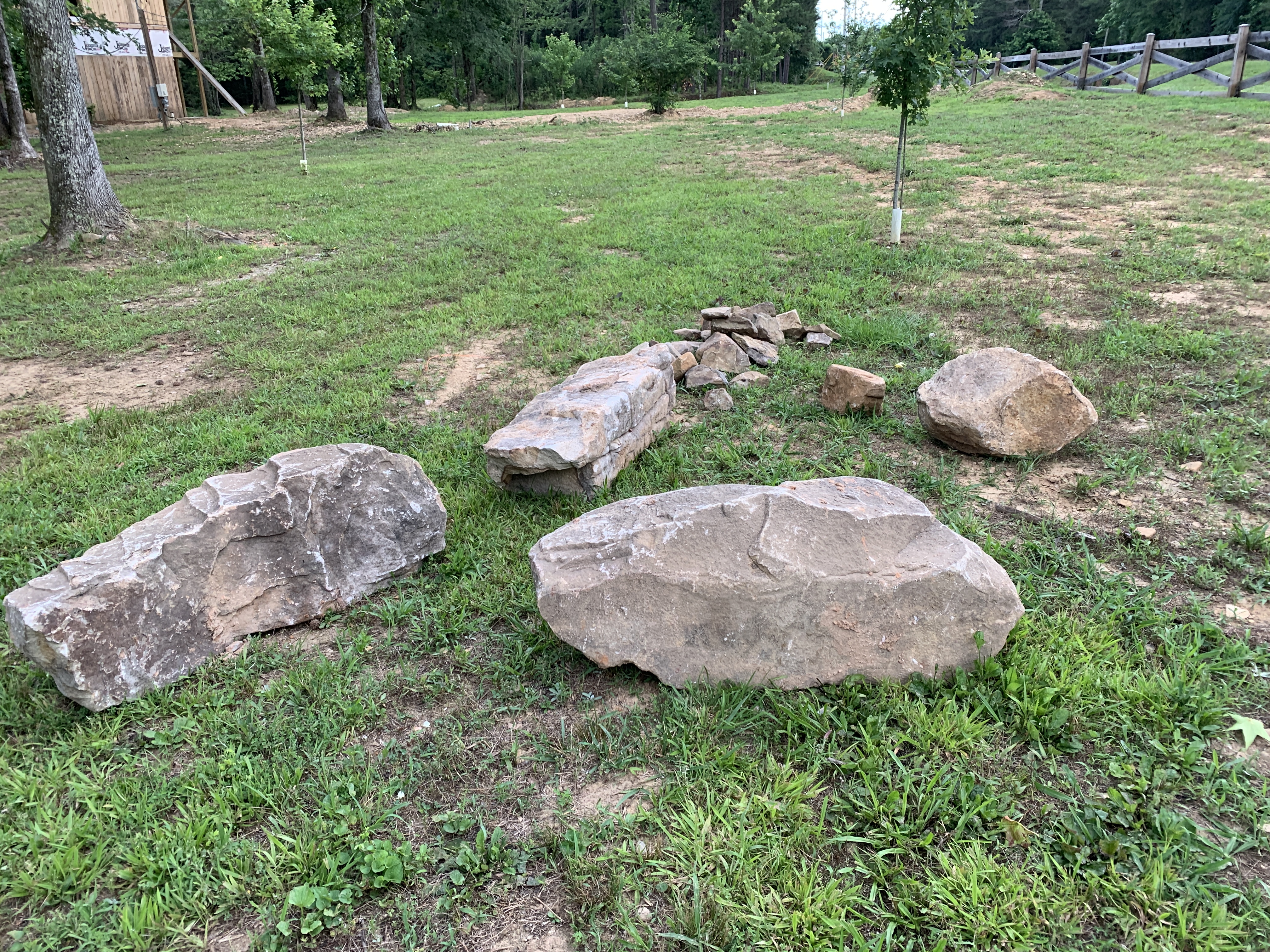
Whew! This is a beast of an undertaking. While I have a few boulders on the property, I decided I also wanted some smoother, bigger “river” rocks. So the local search began, and I ended up at Miller Landscape Supply in Dearmanville, AL. I found the perfect rocks, with a carload of kids, in the biggest storm that’s passed through the area in a while…and I had my husband pick them up in a flatbed truck that he borrowed from a friend. The load weighed close to 2 tons but looks so sparse in the photo I took. I will include photos of the pile I already had, plus the ones I purchased. Drilling begins tomorrow, and I hope the rain hasn’t postponed the hard work to the point I cannot meet the deadline.
We have been experimenting with mortar, rebar and iron pipe, will be drilling into the ground with an auger as well to be sure that the structure will never topple over (on top of someone’s head…could be deadly). I had not considered the possibly deadly nature of my project. Sheesh!
I’ve considered doing a tall, tapering pillar, instead of the arched shape. This is to be explored tomorrow as we drill. I’ve considered that it being so near the main road, I don’t want it to feel like a misplaced entrance. I want it to stand out as a clear art piece from the road; making it tall and graceful might be the perfect way. We shall see.
Delivered rocks:
The ones I already had:
Powhiri (draft artist statement)
Stephanie Hardin
Our property in Choccolocco, Alabama has been a labor of love since 2016, when we moved to this rural area. Differing from the community in many ways, our farm, Hippie Hollow, and the people who love it, have a lot of community buzz surrounding what goes on there. Whether we are opening a halfway house, growing weed (not legal here yet!) or UFO watching, it’s always news to us when we hear what we’re up to. Passionate about the arts and the environment, our goal has been to host classes, camps and events for the community—whatever size that is or becomes, all are welcome. It’s just taken us a bit longer to get the infrastructure in place than we’d hoped.
Bringing a “welcome” structure to the front of my property is the main goal of this project. I hope that the community can see our passion for found objects, the earth, the arts and our permanence in the community. The artist whose work I am most inspired by for this stone project is Carl Peverall. On his website, he explains that the rock work he does is called “Powhiri” (poe’-fur-ee), which means “welcome” in the Mairi language.
I keep thinking about a projection on this white wall. I did my little piece against the wall and like the idea of using again while it is part of my temporary home, in the camper. Since I’ve always liked making/teaching Ojos de Dios (God’s Eyes), I thought about making tiny ones out of needles and string…maybe beads too. The thought is to tie into the meaning of Ojos de Dios in Mexican culture and to project the image/silhouette of these onto the wall, which is symbolic to me in the divisive culture being encouraged by the current POTUS & administration.
The Ojo de Dios or God’s eye is a ritual tool that was believed to protect those while they pray, is sometimes thought of as a magical object, and an ancient cultural symbol evoking the weaving motif and its spiritual associations for the Huichol and Tepehuan Indians of western Mexico. The Huichol call their God’s Eyes Sikuli, which means “the power to see and understand things unknown.”
Frame/ something to build support (scrap wood here? Check tool inventory.
Update as of 5/29/20… “Sikuli”
I am building the frame. It is coming along nicely. I used different width PVC pipe, silicone adhesive, duct tape, scrap metal and wire. I have never worked with silicone adhesive and think I’m in love! The frame has ended up feeling very “broken fence,” which is what I was going for with the statement.
The time spent has taken every spare moment, between making the thread/wooden pieces that will be hanging, to sculpting this frame, to doing research to find the right audio and lighting to play for projection staging. I’ve driven around town to find the perfect wall but cannot get permission to use the one I have my eye on. I need an electric outlet, so I have to make sure it’s a place that’s open/will let me plug in for the projection.
Our world has come to a halt due to the pandemic. Amid working on my master’s degree in art education through the University of Florida, I’m finding it a little overwhelming thinking about my students and not being able to reach out to them. Since I know many of them come from low-income households and have limited art supplies, if any, I made this video:
We studied Picasso’s Blue Period in February and painted the whole school blue…basically! Luckily, our custodian is super awesome and said “I’m just glad the kids are enjoying it!” You know how it is, specks of blue end up in the darnedest places!
We looked at Picasso’s work across the years and what led him to the “blues.” We revisited our warm/cool color discussion and went to town with our drawings. They were instructed to draw something simple that they could use as a rough outline for their tints and shades of blue. Many of them had never mixed paints but did well exploring the various shades they could create. I was proud of their end results, because they were so unique and looked gorgeous hanging in the hallway. I’m hoping the kids will be inspired and proud to take their work home to their families!
For October, we dove into the work of Jean-Michel Basquiat, one of my favorites. I thought the dark nature of his work was appropriate for the season of Halloween! The kids enjoyed hearing his life story and journey to becoming a world-famous artist. We read the book Radiant Child, and we also watched the Ted Talk about Basquiat- although I cut it off at 3:45 due to it mentioning the nature of his death.
We talked about his hard lines, the roughness of his work and how any subject can be seen as or become art. It was a hurdle for some of them to let loose and gain confidence for a project with “no rules.” (their only rules were to share pencils!) Many of them got a kick out of signing their work “SAMO,” as Basquiat did. Their drawings using (high quality) colored pencils were amazing!
My kids at Golden Springs amaze me! We tried this warm/cool color study. We drew the lines in light graphite pencil with erasers handy. When they were content with their framework, we began painting. This took the full hour & the kids really enjoyed it. We liked displaying the work throughout the hallways and even downtown!






 Stephanie Hardin